 Qiu's Growth Journey
Unlock Your Ability Conversion Path
 Cooper
1379 words
7 minutes
Cooper
1379 words
7 minutes 
In my article 《These 3 Obstacles to Ability Growth, How Long Have They Been Hindering You?》, I introduced and kicked away the stumbling blocks that hinder ability improvement.
Today, let’s talk about the pathway of ability growth.
The Curse of “Understand When Seeing, Fail When Doing”
Have you ever had this experience: you’ve seen many tutorials, read thick professional books, or even enrolled in expensive courses, but when the critical moment comes, you’re still at a loss, unable to produce results?
In my first few years of work, I was in this state. After years of refinement, I’ve summarized a methodology that I want to share with you in detail today, hoping it can give you some inspiration.
What is personal ability? Simply put, it is the probability of achieving goals through doing things or solving problems. In specific situations, ability is your probability of integrating information, knowledge, and practice to ultimately produce results.
This process is like an inverted triangle: from broad information input, to filtered internalized knowledge, to focused practical results, crystallizing step by step, and finally forging your ability.
I will break down this ability conversion path from three key aspects — sources and quality of information, acquisition and internalization of knowledge, and comprehensive application of practice.
Whether you’re a workplace newcomer or a seasoned entrepreneur, you can find leverage points for improvement. Let’s begin!
Information: The Foundation of Ability

Where does ability begin? The answer is information.
It is the raw material for understanding the world and solving problems. However, information is not better the more you have; the key lies in the diversity of sources and the level of quality.
In the age of information explosion, we are surrounded by countless fragments every day: valuable articles in social media, fast-food tutorials in short videos, complex results from search engines… But have you thought about how credible this information is? Is it really useful to you? Actively screening information and ensuring quality is the first step in ability conversion. For a more detailed introduction, you can refer to my previous article 《In the Age of Information Flood, Do You Actively Strike Out?》. Here, I’ll briefly introduce three steps:
- Diverse Sources: Information can come from books, expert advice, social media, and even observations in life.
- Quality Assessment:
- Judge the source of information (is it original information, try to find first-hand information)
- Judge the authority of information (is it supported by data? is the source professional?)
- Judge the timeliness of information (is it outdated?)
- Judge the completeness of information (is it comprehensive?)
- Active Filtering: Rather than passively accepting, it’s better to seek answers with questions in mind.
Let me give an example from my own experience:
When I just graduated and was learning MFC, there were many tutorials online. I looked at many of them, but when I started programming, even copying the original text verbatim wouldn’t compile.
Text tutorials didn’t work, so I switched to video tutorials. After watching the videos, I was even more confused - the tools introduced in the videos had no download source, and I was stumbling around aimlessly.
Finally, I came across “Understanding MFC” by Hou Junjie, which was like finding a motherlode. With clear thinking and detailed examples, this book was where I finally started to get a grasp on the subject.
After this experience, when learning Linux later, I again verified the importance of information sources and quality. Similarly from a Taiwanese author, “Bird Brother’s Linux Private Kitchen” opened the door to my Linux operating system learning.
Final Conclusion: The quality of information determines the starting point of subsequent learning. Low-quality information not only wastes time but also dampens your enthusiasm, quickly leading you from entry to abandonment.
Internalization: From Input to Mastery

With quality information, the next step is to transform it into knowledge that belongs to you.
Information is scattered, knowledge is structured; and internalization is about integrating knowledge into your thinking and behavior, becoming part of your ability.
There are many channels for acquiring knowledge, such as self-learning a book, attending a lecture, exchanging with experts… The key is to find a way that suits you.
For example, people who like hands-on activities shouldn’t just read books; they should practice through specific projects for the most obvious effect.
People who like to think are more suited for deep reading, either one book or several books on the same topic.
Internalization is not rote memorization, but a process with a pattern. I break it down into 3 steps:
- Understanding: Break down knowledge points and establish connections with existing concepts. For example, when learning programming, imagine “loops” as repetitive tasks in life.
- Memorization: After understanding the concepts, you have a general outline in your mind. At this point, you can explain it to people around you, deepening your memory while also promoting social interaction.
- Trying: This step is most important. You can try in small steps or on a small scale to avoid putting too much pressure on yourself. The purpose of this step is to verify your understanding.
The effectiveness of these three steps varies from person to person, depending on methods and focus. For instance, using the Feynman learning method (teaching others) is 10 times more efficient than just learning by yourself; when interested and with clear goals, the internalization results are more solid.
Recently, due to work reasons, I needed to write a project in Python (clear goal). After organizing the requirements, I used Cursor to first write a complete design document, then broke down the tasks (method), tried multiple prompts and rules (trying), and finally, when delivering the project, I had also learned Python, not only understanding the code generated by AI but also pointing out bugs written by Cursor (internalization).
Practice: The Stage of Ability

If information is the raw material and knowledge is the semi-finished product, then practice is the final product delivery. Practice is not only the application of knowledge but also a synthesis that combines decision-making, effort, attitude, and a bit of luck.
Practice doesn’t have standard answers like exams; it’s full of variables:
- Knowledge Application: How to apply what you’ve learned in the right place?
- Decision-Making Ability: When facing multiple-choice situations, how to make trade-offs?
- Attitude and Effort: Optimistic or pessimistic, persevere or give up - mentality and level of effort often determine success or failure.
- External Factors: Luck and environment also play a crucial role.
Interestingly, the process of practice not only has output but also input. Each failure is feedback, telling you what needs adjustment. For example, if a product launch has no traffic, it might be because the promotion channel wasn’t chosen well; if a public account has low followers, it might be because your titles aren’t attractive enough.
In 2015, when I started a business doing containerization platforms, Docker was gradually being recognized by the IT circle (information). We learned relevant knowledge and developed a container management platform (practice), confidently released it, but the sales were dismal (practice failure). We collected user feedback, found the problem, adjusted the strategy, open-sourced the core functionality, provided a private deployment version, and that’s when we had a glimmer of hope (feedback optimization).
Practice is the testing ground for ability; only through trial and error and iteration can information and knowledge truly crystallize into results.
The Inverted Triangle of Ability Conversion
Looking back, the conversion path of personal ability is like an inverted triangle:
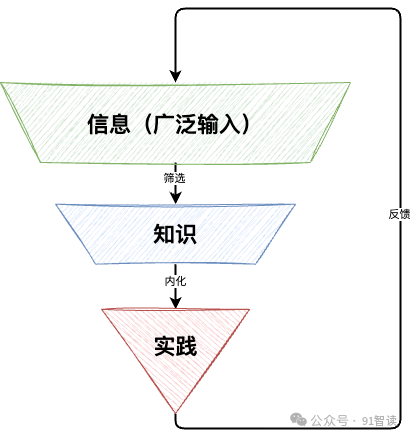
- Top Layer: Massive information input, broad but messy;
- Middle Layer: Filtered internalized knowledge, structured and controllable;
- Bottom Layer: Tempered by practice, manifesting ability.
The conversion process is not one-way; the results of practice feed back to the information layer, initiating a new round of optimized conversion, ultimately forming a closed loop of ability growth.
That’s all for today’s content. You can reflect on: Is your information source of high quality? Is your knowledge internalization deep enough? How’s your efficiency? Have you adjusted promptly in practice? Try to optimize one of these steps and see the effect. I hope this article can give you some inspiration and that you can find your own model of ability growth.
👇Scan the QR code with WeChat to follow “91 Wisdom Reading” for daily updates and grow together.

👇Welcome to add me as a WeChat friend to chat about stories of growth.
